The Social Security System (SSS) in the Philippines is ramping up efforts to increase contributions from self-employed professionals in 2025, underscoring compliance for both individual contributors and businesses that engage independent workers. This guide breaks down how to compute and pay SSS contributions for self-employed individuals in the Philippines, covering the latest rates and compliance tips for 2025.
Why SSS Contributions Matter for Self-Employed Professionals in the Philippines
For self-employed professionals, making regular contributions to the Social Security System (SSS) is a legal requirement and a crucial investment in long-term financial security. However, many freelancers, consultants, and small business owners unintentionally overlook this obligation, risking penalties and losing access to key benefits.
By staying compliant, self-employed individuals gain access to essential financial protections, including:
- Retirement pensions– Ensures financial security when they stop working.
- Disability and sickness assistance– Provides income support during health setbacks.
- Maternity benefits– Helps female professionals manage income loss during pregnancy.
- Death and funeral grants– Offers financial aid to families in times of loss.
- Loan programs– Gives access to short-term financial assistance when needed.
For businesses, on the other hand, working with self-employed professionals who actively contribute to SSS reduces compliance risks, misclassification issues, and fosters a more stable, financially secure workforce. It also enhances credibility when engaging with clients and partners, demonstrating a commitment to ethical and structured professional relationships that attract top talent in the country.
A Step-by-Step Guide to Computing and Paying SSS Contributions in the Philippines
Determine Your Monthly Income for SSS Contributions
Your SSS contribution is based on your declared monthly earnings, which determine your Monthly Salary Credit (MSC) and corresponding contribution bracket.
- Self-employed professionals who deduct business expenses, such as freelancers, and small business owners, typically declare net income– the amount earned after expenses. Their MSC is calculated based on this adjusted figure.
- Those with fixed earnings, such as consultants on retainers, may declare gross income– the total amount earned before deductions, if it accurately represents their earnings.
If your income fluctuates, you can adjust your declared income within the allowed MSC brackets to ensure accurate contributions. Self-employed SSS members can change their MSC without providing proof of earnings as long as it’s not lower than the prevailing minimum MSC (₱ 5,250).
Calculate Your Contribution Based on the Latest Rates
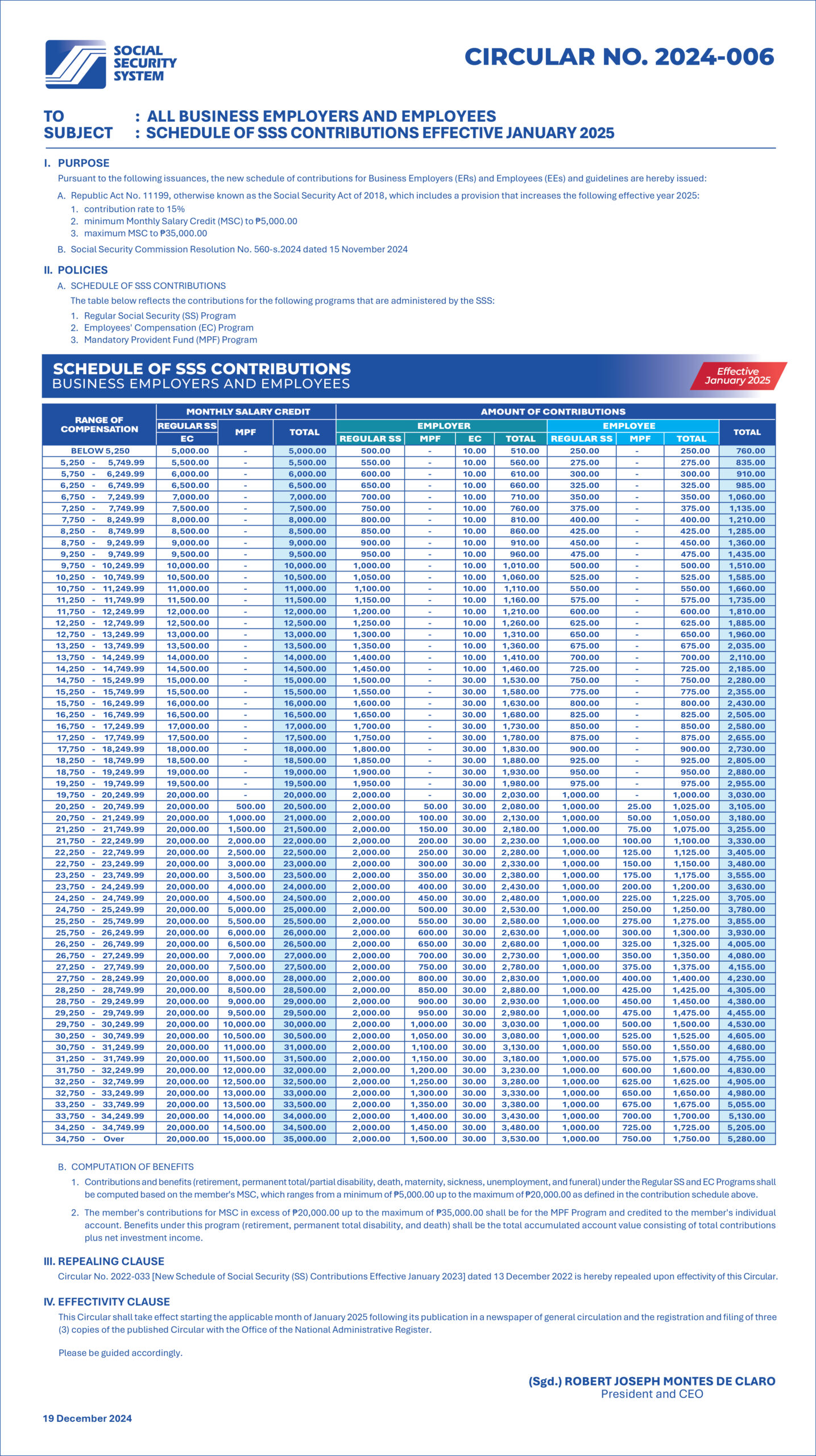
As of January 1, 2025, the SSS contribution rate for self-employed professionals increased to 15% of their Monthly Salary Credit (MSC). Since self-employed professionals pay both the employee and employer share, the total contribution will be based on the latest SSS Contribution Table. To determine your contribution:
- Locate your MSC bracket in the SSS table based on your declared monthly income.
- Multiply your MSC by the 15% contribution rate to get your total SSS contribution.
- If your MSC falls between two brackets, use the higher bracket.
How to Pay Your SSS Contributions Effectively
Once you’ve determined your MSC and corresponding contribution amount, the next step is ensuring timely and accurate payments. The SSS provides multiple channels for self-employed professionals to contribute:
- Online Payment: You can pay via the SSS website or the SSS mobile app. Using your SSS number, you can securely make payments through your bank account or other accredited payment channels.
- Over-the-counter Payments: Payments can be made at authorized SSS payment centers, including partner banks and local branches.
- Monthly Contributions: Staying compliant requires making contributions on or before the last day of the following month to avoid penalties and lapses in benefits.
If you work with self-employed professionals, ensuring SSS compliance means correctly identifying workers as independent contractors or employees, tracking their contributions, and processing payments on time. Alternatively, RecruitGo’s managed payroll service can handle this in your stead and ensure proper worker classification, record-keeping, and calculating and reporting contributions on time, without delays.
SSS Contribution Table for Self-Employed Professionals (2025)
The Social Security System (SSS) provides a full range of contribution brackets based on different income levels, but for simplicity, the table below highlights key brackets to give you a quick reference. With the 2025 rate increase, self-employed professionals must ensure they’re contributing the correct amount based on their Monthly Salary Credit (MSC).
| Range of Compensation (₱) | Monthly Salary Credit (MSC) | Amount of Contributions | Monthly Contribution Rate | |
| Regular SS | Regular SS | EC | Total | |
| Below 5,250 | 5,000 | 510 | 10 | 760 |
| 5,250 – 5,749.99 | 5,500 | 560 | 10 | 835 |
| 5,750 – 6,249.99 | 6,000 | 610 | 10 | 910 |
| 6,250 – 6,749.99 | 6,500 | 660 | 10 | 985 |
| 6,750 – 7,249.99 | 7,000 | 710 | 10 | 1,060 |
RecruitGo’s Salary Calculator makes it easy to determine your SSS, PhilHealth, and Pag-IBIG contributions, based on your income. Whether you’re a self-employed professional managing your own contributions or a business managing freelancer payments, this tool simplifies the process. If you prefer full payroll and compliance support, get in touch with our team through the form below!
Simplify SSS Compliance in the Philippines with RecruitGo’s Employer of Record Services
Under Republic Act No. 11199, self-employed professionals earning at least ₱1,000 a month must contribute to SSS, while businesses hiring freelancers must avoid misclassification to prevent legal risks. For employers, non-compliance can lead to fines (₱5,000–₱20,000), imprisonment (6+ years), and a 3% monthly penalty on unpaid contributions.
As your Employer of Record (EOR), RecruitGo acts as the legal employer of your independent workforce. We’ll take full responsibility for SSS registration, handling your overall payroll and labor compliance:
- Legally Compliant Worker Classification– Avoid DOLE and BIR misclassification risks that commonly result in fines or back payments.
- End-to-End Payroll Solutions– We manage SSS, PhilHealth, and Pag-IBIG deductions, filings, and remittances, ensuring compliance with Republic Act No. 11199 (Social Security Act of 2018) and the latest 2025 SSS contribution rates.
- Expand Without a Local Entity– Attract and manage top talent without setting up a legal entity. We handle everything from employment contracts to benefits administration, and tax compliance.
Looking to scale your freelance workforce? We also help businesses set up and manage remote work teams across the Philippines and Southeast Asia– from legal compliance to workspace solutions. Get in touch today to simplify your SSS compliance or remote hiring strategy!
FAQs about SSS Contributions for Self-Employed Professionals in the Philippines
No, businesses are not legally required to pay SSS contributions for self-employed professionals. However, companies must ensure that independent workers are correctly classified to avoid labor misclassification risks. Verifying that self-employed professionals contribute to SSS helps businesses maintain compliance and avoid potential legal disputes.
The SSS contribution rate for self-employed individuals in 2025 is 15% of their Monthly Salary Credit (MSC), covering both the employee and employer share. Self-employed professionals must calculate their contributions based on their declared income and pay them directly to SSS to maintain active membership and access benefits.
Yes, it’s common for businesses to partner with an established Employer of Record (EOR) service such as RecruitGo to manage SSS contributions and other mandatory benefits for self-employed professionals. This ensures compliance without businesses having to classify workers as employees, helping streamline payroll processing, tax compliance, and regulatory requirements.
Late payments incur a 2% monthly penalty for individuals and 3% for employers until settled. Employers may also face additional fines, legal action, or even imprisonment for non-compliance.
Missing contributions can also result in benefit lapses, delays in loan approvals, and the loss of retirement, maternity, or disability benefits. Self-employed professionals must pay contributions on or before the last day of the following month to remain eligible for SSS benefits.
Hiring self-employed professionals who do not contribute to SSS can create misclassification risks. If an independent worker is found to be functioning like a regular employee– such as working under direct control, receiving fixed compensation, or having an exclusive arrangement, the business may be held liable for unpaid employer contributions, back wages, and potential legal penalties. Ensuring that self-employed workers are properly registered and contributing to SSS helps businesses avoid labor disputes and compliance issues.