Global Payroll Service
Run Payroll Across 40+ Countries from One Provider.
Every country has its own tax brackets, social security systems, mandatory bonuses, and filing deadlines. RecruitGo processes payroll in local currency, calculates contributions, withholds income tax, and delivers compliant payslips.
How Global Payroll Works with RecruitGo
Global payroll means processing employee salaries, statutory deductions, tax withholdings, and mandatory contributions in each country where you have employees. Each country has its own tax authority, social security agency, contribution rates, filing deadlines, and currency. RecruitGo processes payroll locally in each country through our own entities.
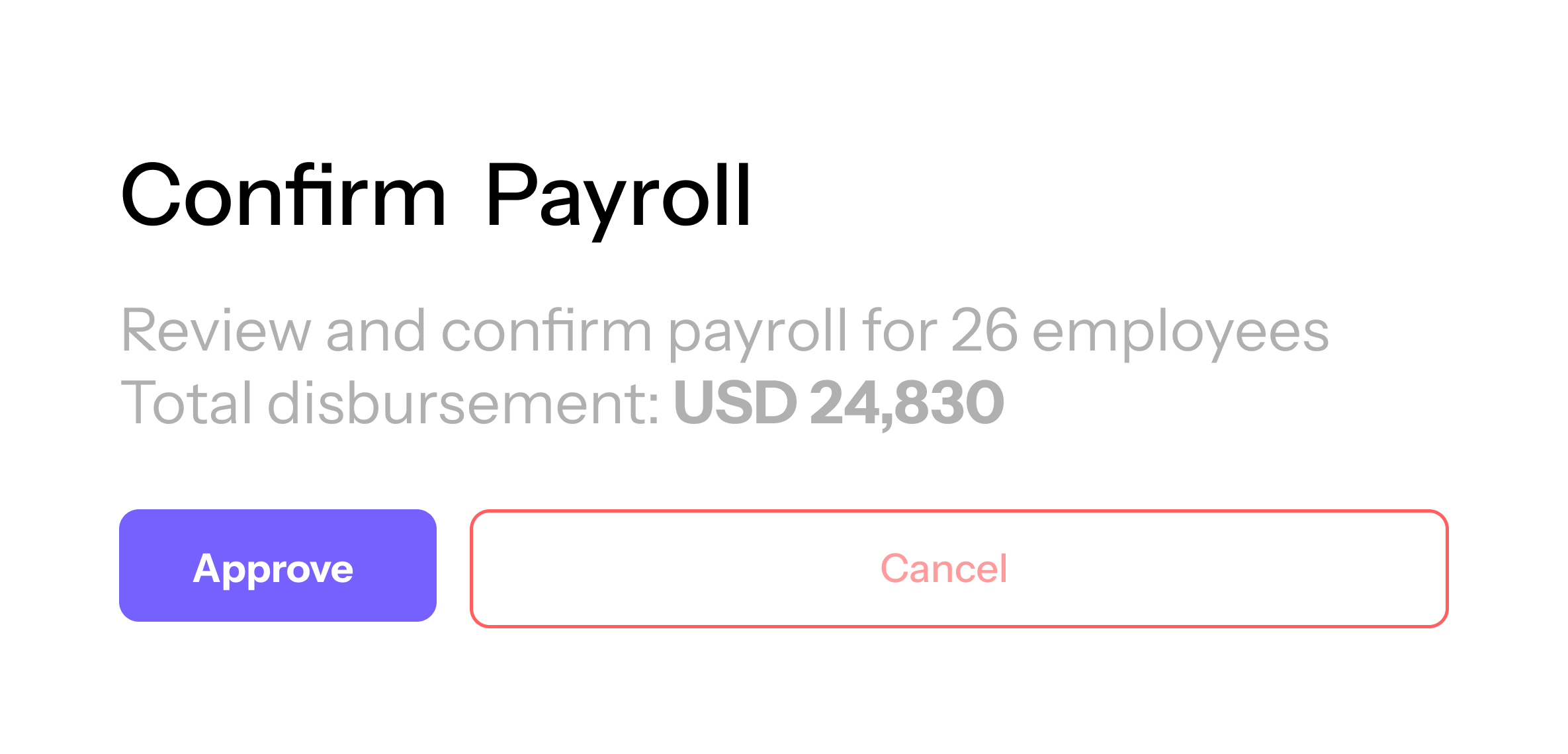
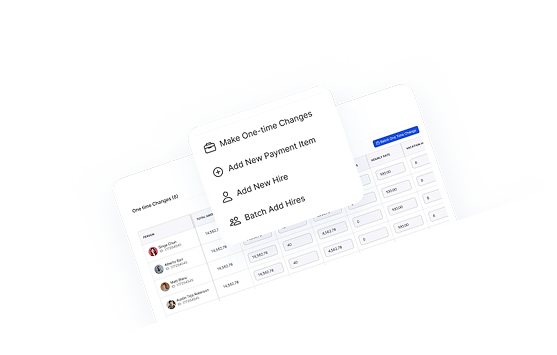
You define each employee’s compensation package. Before each pay cycle, you review and approve any changes (new hires, raises, bonuses, terminations). This is the only step that requires your input.
We calculate gross-to-net for each employee based on that country’s current tax tables, social security rates, mandatory bonuses (13th month, THR, aguinaldo, prima), and any applicable deductions. Rates change frequently. We track every update.
We pay employer and employee social security contributions, income tax withholdings, and any parafiscal charges to the relevant authorities by their deadlines. In the UAE, we process salary through the Wage Protection System. In Indonesia, we file BPJS and PPh 21. In Colombia, we deposit cesantias.
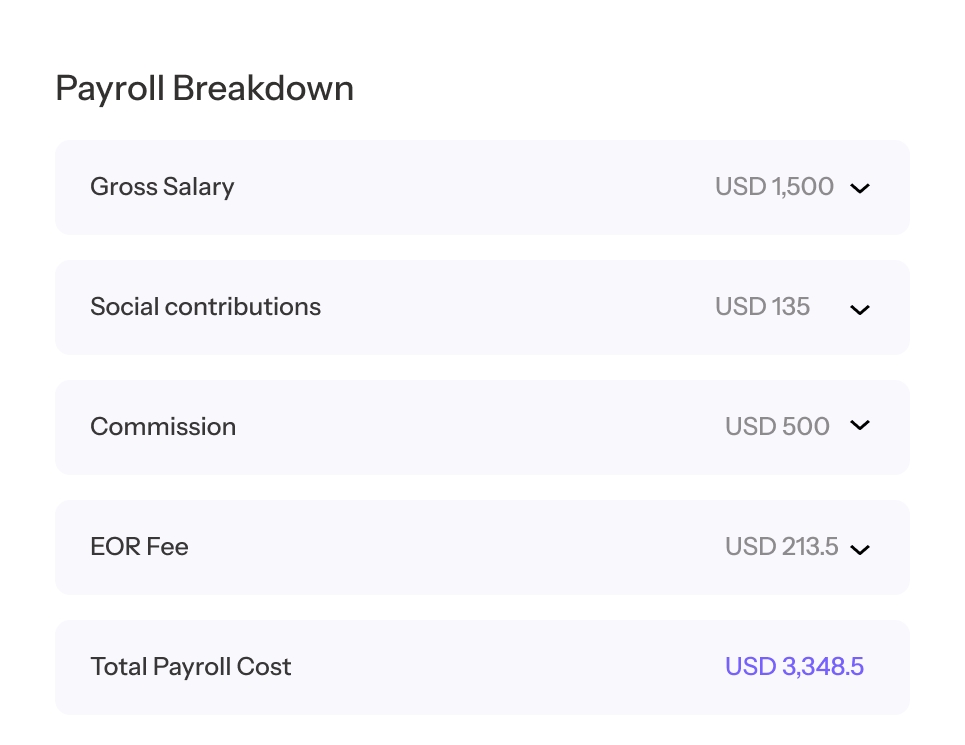
Employees are paid in local currency to their local bank account. They receive compliant payslips showing gross salary, all deductions, employer contributions, and net pay. You receive a consolidated payroll report across all countries.
Payroll by Country
Select a region to see the countries where RecruitGo processes payroll. Each country page covers exact employer and employee contribution rates, tax brackets, mandatory bonuses, leave entitlements, and a sample cost breakdown.
ASEAN’s payroll complexity stems from country-specific social security systems, mandatory religious contributions (Malaysia, Indonesia), varying 13th month rules, and rapidly changing labor codes. Every country has its own tax withholding system, contribution caps, and filing deadlines.
BPJS health + employment, THR bonus, progressive tax 5–35%
SSS, PhilHealth, Pag-IBIG, 13th month pay, BIR withholding
SSF 5%, new Employee Welfare Fund from Oct 2026, PIT 0–35%
Social insurance, health, unemployment, union dues, PIT 5–35%
EPF, SOCSO, EIS, HRDF, monthly tax deduction (PCB)
CPF 17% (citizens/PRs only), SDL, progressive tax 0–24%
What's Included in Global Payroll
Payroll Processing
Tax & Contributions
Compliance Management
Reporting & Support
Common Payroll Challenges by Region
Each region has its own compliance traps. These are the issues that cause fines, employee complaints, or audit failures when companies try to manage multi-country payroll internally.
| Region | Key Challenge | What Goes Wrong |
|---|---|---|
| Southeast Asia | Multiple social security systems per country | Indonesia has 5 BPJS programs with different rates and caps. Philippines has 3 agencies (SSS, PhilHealth, Pag-IBIG). Getting any rate wrong triggers penalties and employee shortfalls. |
| Southeast Asia | Mandatory religious and cultural bonuses | Indonesia’s THR must be paid before Ramadan. Philippines’ 13th month is due by December 24. Thailand’s bonus customs differ from legal requirements. Missing dates causes labor complaints. |
| South Asia | State-level compliance variation | India has 28 states with different professional tax rates, minimum wages, and Shops & Establishments Act rules. A payroll setup for Karnataka does not work for Maharashtra. |
| Latin America | Inflation-indexed everything | Argentina adjusts social security caps monthly, tax brackets twice yearly, and CBA salary scales quarterly. Colombia’s minimum wage changes every January, shifting contribution thresholds. |
| Latin America | Mandatory annual benefit calendar | Colombia requires four separate benefit payments (prima, cesantias, interest on cesantias, vacation) at different times. Argentina’s aguinaldo is calculated differently each semester. |
| Middle East | WPS and visa-linked employment | UAE salaries must flow through the Wage Protection System. Late or non-compliant payments trigger MoHRE restrictions. Employment is tied to visa sponsorship. |
EOR vs Payroll Service: Which Do You Need?
These are two different services. Understanding which one you need depends on whether you have your own legal entity in the country.
RecruitGo is the legal employer. We hire the employee on your behalf, handle their contract, visa, benefits, and payroll. You do not need a local entity.
You are the legal employer. You have your own entity in the country. RecruitGo processes payroll, handles tax filings, and remits contributions on your behalf.
Many companies use both: EOR in countries where they are testing the market or have a small team, and payroll service in countries where they have an established entity. RecruitGo supports both models, and you can transition from EOR to payroll service as your team grows.
Employer Cost Comparison Across Countries
The total employer burden (social security + mandatory bonuses + insurance) varies dramatically by country. This table shows the approximate total loaded cost as a percentage of gross salary for a mid-level employee.
| Country | Employer SS | Mandatory Bonuses | Key Extras | Total Loaded Cost |
|---|---|---|---|---|
| 🇦🇪 UAE | 0% (expats) | None | Gratuity ~6–8%, health | ~110–115% |
| 🇸🇬 Singapore | 17% CPF | None | SDL 0.25% | ~117% |
| 🇹🇭 Thailand | ~5.25% | None statutory | EWF from Oct 2026 | ~108–112% |
| 🇵🇭 Philippines | ~10–12% | 13th month 8.33% | De minimis benefits | ~122–128% |
| 🇮🇩 Indonesia | ~10–12% | THR 8.33% | BPJS 5 programs | ~127–133% |
| 🇮🇳 India | ~13% | None statutory | Gratuity after 5 yrs | ~115–120% |
| 🇵🇰 Pakistan | ~11–12% | None statutory | Gratuity after 1 yr | ~116% |
| 🇨🇴 Colombia | ~25% | Prima 8.33% + cesantias 9.33% | ARL 0.5–8.7% | ~145–155% |
| 🇦🇷 Argentina | ~24–27% | Aguinaldo 8.33% | ART 1–5% | ~135–146% |
| 🇧🇷 Brazil | ~28–32% | 13th salary 8.33% | FGTS 8% | ~155–170% |
* Total loaded cost = gross salary + all mandatory employer contributions + mandatory bonuses + insurance, expressed as a percentage of gross. Does not include EOR/payroll service fees.
Frequently Asked Questions
Global payroll is the process of calculating and paying employee salaries, tax withholdings, and social security contributions across multiple countries. Each country has its own tax tables, social security rates, mandatory bonuses, and filing deadlines. A global payroll provider processes payroll locally in each country, ensuring compliance with local regulations and paying employees in local currency.
With global payroll, you have your own legal entity in the country and you are the legal employer. The payroll provider processes salaries and contributions on your behalf. With EOR, the provider is the legal employer. EOR includes payroll plus employment contracts, visa sponsorship, benefits, and compliance. Use EOR when you don’t have a local entity. Use payroll service when you do.
RecruitGo processes payroll across Southeast Asia (Indonesia, Philippines, Thailand, Vietnam, Malaysia, Singapore), South Asia (India, Pakistan), Latin America (Colombia, Argentina, Brazil, Mexico, Chile), and the Middle East (UAE, Saudi Arabia, Qatar). We add new countries regularly.
We process payroll in local currency in each country. Employees are always paid in their local currency. You fund payroll in your preferred currency. We handle FX conversion and provide full visibility into exchange rates and costs.
We monitor regulatory changes in every country we operate in. When rates change (e.g., Indonesia adjusts BPJS caps, Argentina indexes social security caps monthly, Colombia raises the minimum wage each January), we update our payroll calculations automatically.
Yes, but these are different processes. For employees, we process full payroll with deductions, contributions, and payslips. For contractors, we can manage payments and invoicing. We can also help assess whether someone should be classified as an employee or contractor to avoid misclassification risk.
For countries where we already have an entity, we can start processing payroll within 1 to 2 weeks. For EOR in a new country, onboarding a first employee typically takes 3 to 7 business days.
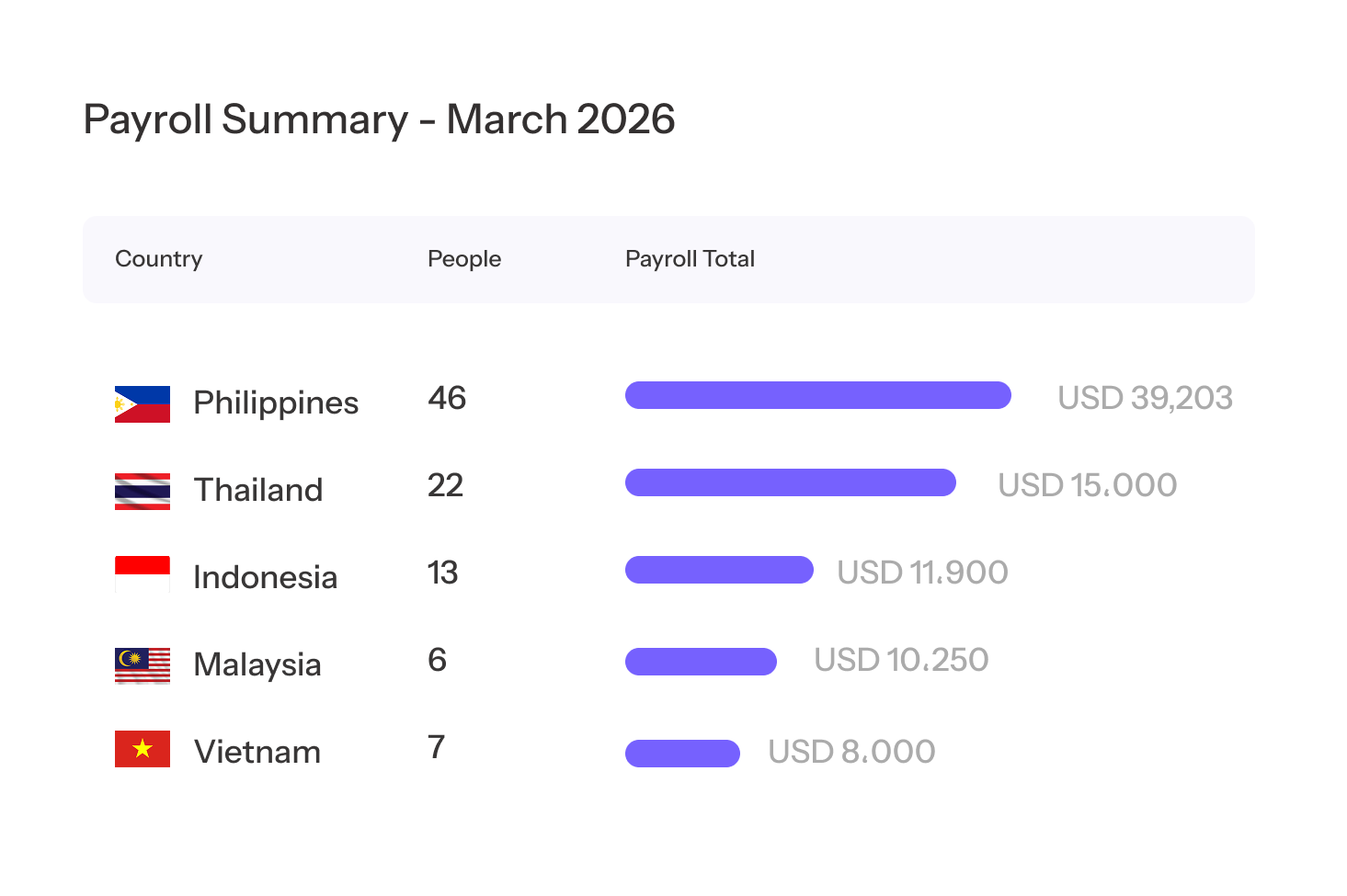
You receive consolidated payroll reports across all countries showing gross salary, employer contributions, employee deductions, net pay, and total cost per employee. Reports can be broken down by country, department, cost center, or any custom grouping.